
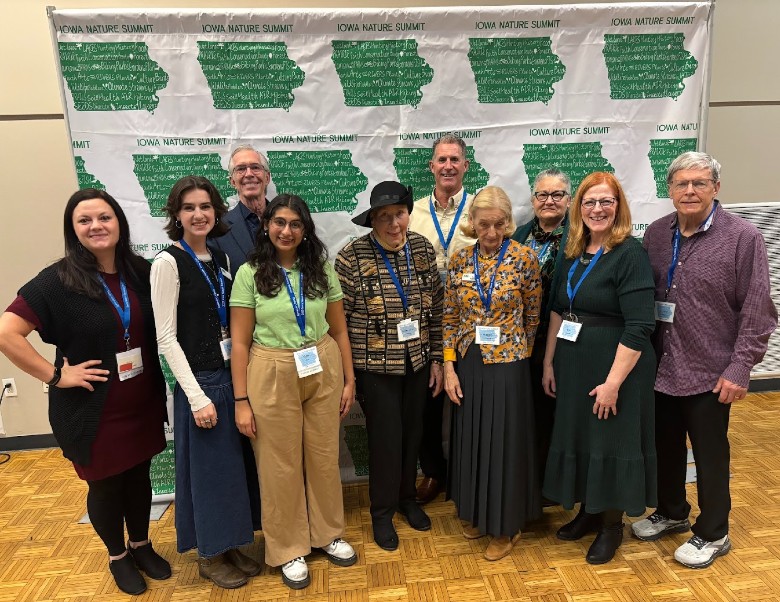
Maggie McQuown’s path back to her family farm wasn’t a straight line. After growing up on the “Taylor Farm” in Red Oak Iowa, which her paternal grandmother’s parents – JE and Retta Taylor – purchased in 1899, she built a career in marketing and advertising that took her to New York City, Downtown Chicago, and Dallas. Maggie never expected to manage or own the farm. In fact, Maggie totally dismissed a conversation she and her father had one day when she was living in New York.
“Why don’t you come back and run the farm?” he asked.
“What? I don’t know anything about farming,” Maggie replied.
“But you know business. You can learn farming.”
Thirty years later, everything changed. That dismissed conversation came true. Here she is running the farm using her business knowledge while learning farming – regenerative ag practices, prairie restoration, cover crops, and more.
A Changed Landscape
When Maggie returned to Montgomery County, the farm she inherited in 2011 looked dramatically different from the place she remembered from the 1950s, ’60s, and early ’70s. Gone were the diverse crops like hay, oats, wheat, and sorghum. The fence rows that once divided smaller fields had been removed. The trees along the eastern side of the creek had been cut down. Everything had been consolidated into expansive fields of corn and soybeans.
“The corn looked over engineered and not natural to me,” Maggie recalls. She and her husband Steve observed the increasing herbicide resistance, disease problems, and fungal issues. “We looked at the system and knew it was just not sustainable.”
Rethinking Legacy
As a fourth-generation farmer with deep emotional ties to the land, Maggie faced a difficult reality: she has no children. While her nieces would love to have a farm, they would never move to Red Oak and Maggie didn’t want to pass the farm to an absentee owner who was not living on and actively engaged in stewarding the land.
“I realized the farm would not go to my immediate family, and I needed to find someone who has the same values and love of the land; someone who sees themselves as a steward for their lifetime and wants to engage in sustainable practices.”
This realization shifted her entire perspective. “I had no choice but to do what was right for the land as opposed to selling it to the highest bidder in exchange for a cushy retirement. Money is not the primary consideration. You can’t take it with you.”
Development Pressure in Rural Iowa
Many assume development pressure only affects areas near Des Moines or other major cities. But even in Red Oak, with a population of 5,500, the threat is real. In the 1970s, Maggie’s father dreamed of purchasing the farm adjacent to theirs. He was outbid by the Red Oak Industrial Foundation. Now, industrial plants interrupt what was once her unobstructed, panoramic view of the East Nishnabotna River valley and Red Oak across the river.
Her farm was rezoned to “industrial and agriculture,” creating the risk that the farm could be targeted for industrial expansion. “I want to ensure that no matter what happens, this land can never be used for anything other than agriculture.”
Why a SILT Easement?
For Maggie and her husband Steve, protecting the land isn’t just about preventing development, it’s about ensuring it can feed people. “We want to feed ourselves and our communities; we believe people need access to healthy food provided by local and regional food systems versus today’s global food system”
While many conservation easements focus on preserving land for its natural beauty and recreational value, SILT’s emphasis on food farming resonates with Maggie’s vision. “If we get to the point where food accessibility is a crucial problem, recreation will be a minor thing. We need to feed people locally.”
Making the Decision Together
What makes Maggie’s situation unique is that she’s already identified the family she wants to steward the land after her. This means the easement decision isn’t hers alone.
“If the easement doesn’t fit the values of the family I’m choosing to steward the land, I need to take that into account,” she explains. “An easement existing in perpetuity is a bit of a scary concept, given how rapidly economic and environmental circumstances can change. This easement has to be something that a landowner truly trusts can weather the test of time.”
However Maggie adds “there’s a lot of room to customize the easement. It’s terms are negotiable and somewhat flexible, so it shouldn’t be a scary thing. Instead, it should be a hopeful thing—a win-win, as long as the easement isn’t too restrictive and folks can individualize it to fit the farm, the current landowner, and the future steward.”
Advice for Other Landowners
For landowners considering a conservation easement, Maggie offers this wisdom: “It’s a heavy decision that requires careful consideration. It’s a long and emotional process, as well as a business decision that affects the future management of the land.”
Most importantly, she emphasizes that the process should give hope, not fear. “You don’t want to restrict someone or tether them to something that won’t work well. The beauty of working with SILT is that there’s room to make it work for everyone—for the land, for the family, and for the future. And, in the long run, I will have the assurance of knowing this land will be stewarded using sustainable farming practices and providing food for future generations.”
Maggie McQuown serves on the board of Sustainable Iowa Land Trust and is currently in discussions to place a conservation easement on her Farm in Montgomery County. Her story illustrates how thoughtful land protection can ensure a sustainable agricultural future for generations to come.